
“To give anything less than your best is to sacrifice the gift.”
– Steve Prefontaine
He never won a gold medal in the Olympics. He never ran a marathon. He was never the fastest runner in the world. We never got to see his true potential. Sad but true Steve Prefontaine was taken away from us too soon.
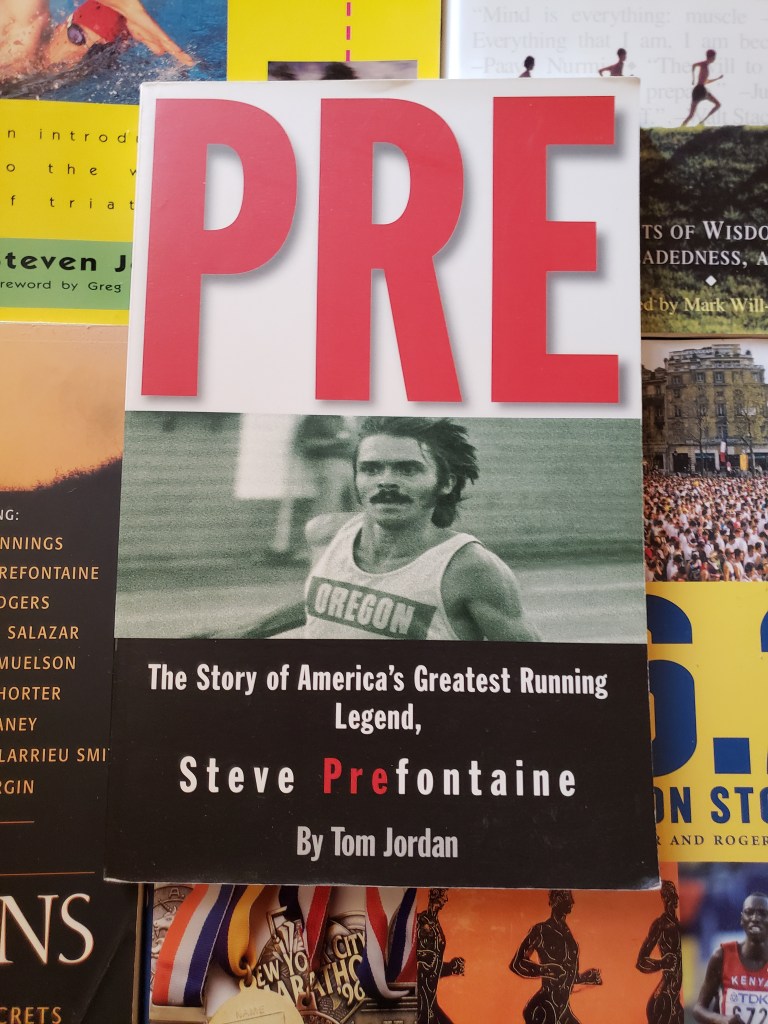
Like a brilliant comet soaring through the midnight sky we only saw him for a moment. A glimpse of greatness that we wanted to hold on to forever. Steve Prefontaine was one of the greatest distance runners of all-time. A bold statement but true. I can think of runners with more medals and world records but I dare you to think of a runner that was more memorable.
Most of the runners from the 1970’s running boom are sadly forgotten but Prefontaine’s legacy has endured the test of time. An iconic figure that transcended the sport of running into the perimeters of pop culture. All you have to do is name drop the name Steve Prefontaine on social media and you will get instant hits from teenagers to senior citizens. Prefontaine was a rock star. It wasn’t about how fast he ran it was the way he ran. Running was like a work of art to him. Like Michelangelo’s vision of the Sistine Chapel his races were his canvas. A masterpiece in the making and a spectacle to behold.
Prefontaine was born on January 25, 1951 in Coos Bay, Oregon. As a kid from a blue-collar working class family running was never a priority to his parents. While they loved and supported him they never took his dreams seriously and even discouraged him from pursuing the sport of running. Others saw Prefontaine as too short, too stocky (ridiculous when you look at how lean he was), and not athletic enough.
No one believed in him at first so what did he do? Did he curl up into a ball and give up? No way. Why? Because he believed in himself. He worked hard, was persistent, and never gave up on his dreams. All that hard work payed dividends because when Prefontaine finished his senior year of high school he was the top two miler and cross country runner in the country. In his high school career he won two state titles in cross country as well as two state titles in the two mile distance. In his senior track season his time of 8.41.5 in the two mile was a national record. A time that was nearly untouchable for almost a decade.
At the age of 18 Prefontaine was already starting to blaze a trail throughout the running community but it wasn’t until he went to the University of Oregon that his running career really took off. Even though he wasn’t recruited by them he made the decision to run for arguably one of the greatest running coaches of all-time Bill Bowerman.
From day one Prefontaine made his mark on campus and never looked back. Thinking about the all-time great collegiate distance runners throughout history I couldn’t think of a single runner that even came close to what he accomplished in track and cross country. Just to reel off a few statistics from 1970-1974 he set collegiate and American records in almost every distance race imaginable from the 2,000m-10,000m. He won three NCAA titles in cross country (1970, ’71, ’73) and four NCAA titles in the three-mile in track (1970, ’71, ’72, ’73). At the time he was the first collegiate runner ever to accomplish this feat in track and only the second runner ever for cross country. An even more impressive feat during that time (at least in my opinion) is that he never lost a single collegiate race that was 3 miles or higher. Not one. Absolutely unbelievable when you think back to Prefontaine’s earlier years in high school when he barely made his high school track team.
While his records were impressive surprisingly that’s not what people think of first when they think of Steve Prefontaine. As I mentioned earlier it was the way he ran. Prefontaine described it as a pure guts race and that if someone was going to beat him they were going to have to die to do it. From the opening gun of the race he would surge to the front of the pack and literally dare other runners to go after him. Most of the top distance runners throughout history and today run even splits or they save their energy for the end of the race when they put in their finishing kick. Both smart approaches but Prefontaine had his own ideas and preferred to run hard from beginning to end. A strategy that (usually) worked in his favor.
His most memorable races were at the historic Hayward Field in Eugene, Oregon. Almost every race he competed in was electrifying and completely sold out. Workers would close their shops early and kids would arrive by the hundreds just get his autograph. Hysteria that was almost similar to a Beatles or Rolling Stones concert. From young to old and from all walks of life Prefontaine’s surreal energy brought everyone in the community to his races. He became a household name across the country and around the world.
When most people think of his races (at least with me) they think of 1972. Why? Because that was the year Prefontaine would finally get to test his limits on the greatest stage in the world at the 1972 Olympics in Munich, Germany. It was also the last and only Olympics that he would ever compete in.
Prefontaine had already set an American record of 13.22.8 in the 5,000m against the savvy veteran George Young. One of the fastest times ever at the distance. At the young age of 21 Steve was coming into the Olympics hot and in contention to make a run for the greatest prize in athletics of winning a gold medal.
Facing a stacked field of seasoned competitors Prefontaine would be put to the ultimate test in the 5,000m final against Lasse Viren. From the early 1970’s-early 1980’s Viren was literally unstoppable in every distance from 5,000m-10,000m. I can really think of only two other runners that could be mentioned in the same breath as him in those distances with Mo Farah and Haile Gebrselassie. That’s it. Nothing but sheer and utter domination between those three titans.
A Palestinian terrorist attack that resulted in the death of eleven Israeli Olympic team members along with a West German police officer just days before the 5,000m final almost ended the games. Most of the athletes including Prefontaine had mixed emotions about competing in the games after the tragedy. They ultimately decided to do so after being persuaded by coaches and to honor the spirit of the games along with the victims.
Despite the horror of this tragedy the games continued and the stage was set for Prefontaine in the 5,000m final. In almost every race that he ever competed in he ran to the front of the pack from the opening gun. In this race he held back and stayed near the middle of the pack. Some say it was by choice others say it was because he was boxed in. Regardless of why he took this approach isn’t completely known. Nevertheless he stayed close to the lead pack and in the last mile he started to make his move. It was a battle between Prefontaine, Lasse Viren, and Mohammed Gammoudi. In the last lap Viren put the hammer down with one of his famous finishing kicks and Prefontaine hung on for dear life. With 200m to go Prefontaine was passed by Viren who won gold (13:26.42) and Gammoudi who took silver (13:27.33) and then eventually was beaten by Ian Stewart who took bronze (13:27.61) right at the finishing line. Prefontaine ended up finishing in fourth (13:28.25).
A gut wrenching loss but still an incredible achievement for a young inexperienced Olympian. It’s true that if Prefontaine held back a little in the remaining lap he could’ve have won the bronze medal. Instead he chose to go for the win at all costs and did whatever it took to challenge Viren. One of the only races that Prefontaine ever lost but one that will always be remembered.
After that race Prefontaine returned to Eugene, Oregon in a state of despair feeling not only disappointed in himself but that he also let his country down. It took a while for these feelings of disappointment to subside but in time they did and he went on to finish his collegiate career and set the world stage on fire after his graduation continuing his reign of dominance.
With the 1972 Olympic games being a distant but painful memory Prefontaine was already thinking about the next Olympic games in Montreal, Canada. As 1975 came around the corner he was in top shape and ready to put his conditioning to the test in the Hayward Field Restoration Meet. He won the 5,000m in style at that event in a tight race against running legend Frank Shorter. Unfortunately that would be the last race that he ever ran.
Later that evening Prefontaine was driving from a party when he died in a tragic automobile accident. His orange 1973 MGB convertible crossed the center line of the road, jumped the curb, impacted a rock wall and flipped, trapping him underneath it. Paramedics found him pinned under the car still alive but he died shortly after. According to reports his blood alcohol level was 0.16. and the main cause of death was traumatic asphyxiation. Amazingly he had no other injuries that contributed to his death. On May 30, 1975 Prefontaine died tragically at the age of 24.
The running community will never be the same but his legacy remains. People of all ages will always remember him not for his records but the way he made them feel. He inspired us to go out there and chase our dreams. He made all things seem possible. His sheer will, unwavering passion, and unmatched toughness will always be remembered. His spirit lives on in each and everyone of us. He will never be forgotten. We miss you and thank you for inspiring us. Stay positive. Stay focused. Never surrender.
Alex Reid
 Move At Will